
Children learn about the world through their senses long before they can talk about it. Sensory activities — play that engages touch, sight, sound, smell, taste, movement, and balance — help build the neural connections behind language, motor skills, and problem-solving. But what works for a 6-month-old won’t hold a 4-year-old’s attention, and what excites a toddler might overwhelm an infant.
This guide breaks down age-appropriate sensory activities by stage, so you can match the play to where your child actually is developmentally.
Why Sensory Play Matters at Every Age
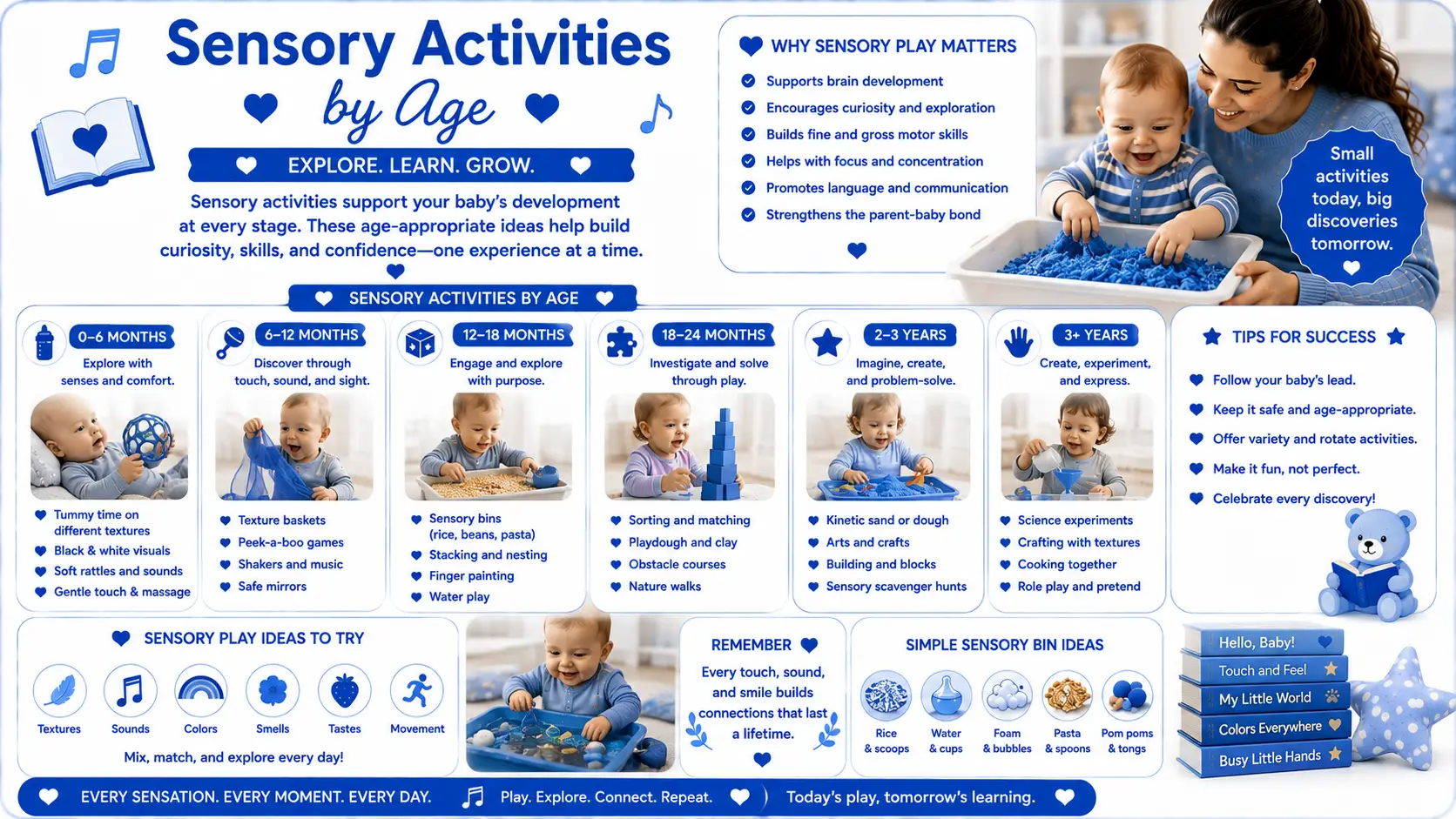
Sensory processing — the brain’s ability to organize and respond to information from the senses — develops gradually from infancy through early childhood. Regular sensory activities support:
Brain development — hands-on exploration builds neural pathways used for learning
Fine and gross motor skills — grasping, pouring, and scooping strengthen hand and body control
Language development — describing textures, sounds, and smells expands vocabulary
Emotional regulation — repetitive sensory input (like squishing dough or rocking) can be calming
Problem-solving and early science skills — cause-and-effect play (what floats, what pours) builds curiosity
The key across all ages is following your child’s lead — offer the activity, then let them explore at their own pace.
Sensory Activities for Infants (0–12 Months)
Infants rely almost entirely on their senses to understand the world, so keep activities simple, gentle, and closely supervised.
0–6 months:
High-contrast black-and-white cards or books
Soft rattles and gentle music
Tummy time on different textured blankets or mats
A baby-safe mirror for visual stimulation
6–12 months:
Textured sensory balls and fabric books
Taste-safe sensory bins with oats or rice
Water play in a shallow tub, always supervised
Sensory bags (sealed zip-top bags with gel or water) for safe squishing without a mess
At this stage, sensory play doubles as bonding time — talking through what your baby is touching or seeing helps lay the groundwork for language.
Sensory Activities for Toddlers (1–3 Years)
Toddlers are mobile, curious, and eager to test cause and effect. This is when messier, more hands-on sensory play really takes off.
Sensory bins filled with rice, dried pasta, or beans and scoops for pouring
Water and sand play, indoors or out, with cups and containers for filling and dumping
Finger painting to build fine motor skills and introduce color recognition
Playdough or homemade cloud dough for squeezing, rolling, and shaping
Nature walks to collect leaves, pinecones, or pebbles for a simple sensory scavenger hunt
Bubble play, which combines visual tracking with gross motor movement (chasing and popping)
Toddlers benefit from sensory activities that involve their whole body, not just their hands — think jumping in leaf piles, walking on textured mats barefoot, or dancing to music with different tempos.
Sensory Activities for Preschoolers (3–5 Years)
Preschoolers can handle more complex, multi-step sensory experiences that blend early academic concepts with open-ended play.
Taste-test games — blindfolded fruit or snack tasting to guess by smell and texture
Simple science experiments — color mixing, sink-or-float tests, baking soda and vinegar reactions
Sensory art projects using textured materials, scented markers, or natural items like leaves and flowers
Cooking and baking — kneading dough or measuring ingredients engages touch, smell, and early math skills
Obstacle courses that combine balance, movement, and body awareness (proprioception)
Gardening — digging, planting, watering, and smelling herbs or flowers
At this age, children start connecting sensory experiences to abstract ideas, like sorting objects by texture (“rough” vs. “smooth”) or comparing weights (“heavy” vs. “light”).
Tips for Sensory Play at Any Age
Always supervise, especially with water, small objects, or food-based play
Use taste-safe materials for children who still mouth objects
Expect (and plan for) mess — a splat mat, old towel, or outdoor setup makes cleanup easier
Follow your child’s cues — if they seem overwhelmed, scale back the activity rather than pushing through
Rotate activities to keep engagement high; you don’t need new toys, just new combinations of textures and materials
Final Thoughts
Sensory activities don’t need to be elaborate to be effective. A bin of rice, a patch of grass, or a bowl of water can offer just as much developmental value as store-bought kits — what matters most is consistent, hands-on exploration matched to your child’s age and interests. A few minutes of sensory play spread throughout the day adds up to meaningful growth over time.
FAQ
What are the best sensory activities for each age group?
Infants benefit from gentle, low-stimulation play like textured fabrics and soft sounds; toddlers thrive with hands-on activities like sensory bins, water play, and playdough; and preschoolers are ready for more complex play like simple science experiments, cooking, and sensory art projects.
At what age should sensory play start?
Sensory play can start from birth. Newborns respond well to high-contrast visuals, gentle textures, and calm sounds, while more interactive sensory activities typically begin once a baby has head control, around 4 to 6 months.
How long should sensory play sessions last?
There’s no strict rule, but 10 to 20 minutes is typical for infants and toddlers, while preschoolers may stay engaged for 30 minutes or more, especially with open-ended activities. Let your child’s interest guide the length rather than a set timer.
Is sensory play the same as sensory processing therapy?
No. Everyday sensory play supports typical development for all children, while sensory processing therapy is a targeted intervention, usually led by an occupational therapist, for children with sensory processing challenges. If you have concerns about your child’s sensory responses, talk to your pediatrician.
What household items work well for sensory activities at any age?
Rice, dried pasta, water, fabric scraps, cardboard, wooden spoons, and kitchen containers all make excellent sensory materials. You don’t need specialized toys — everyday items offer plenty of texture, sound, and visual variety for children to explore.